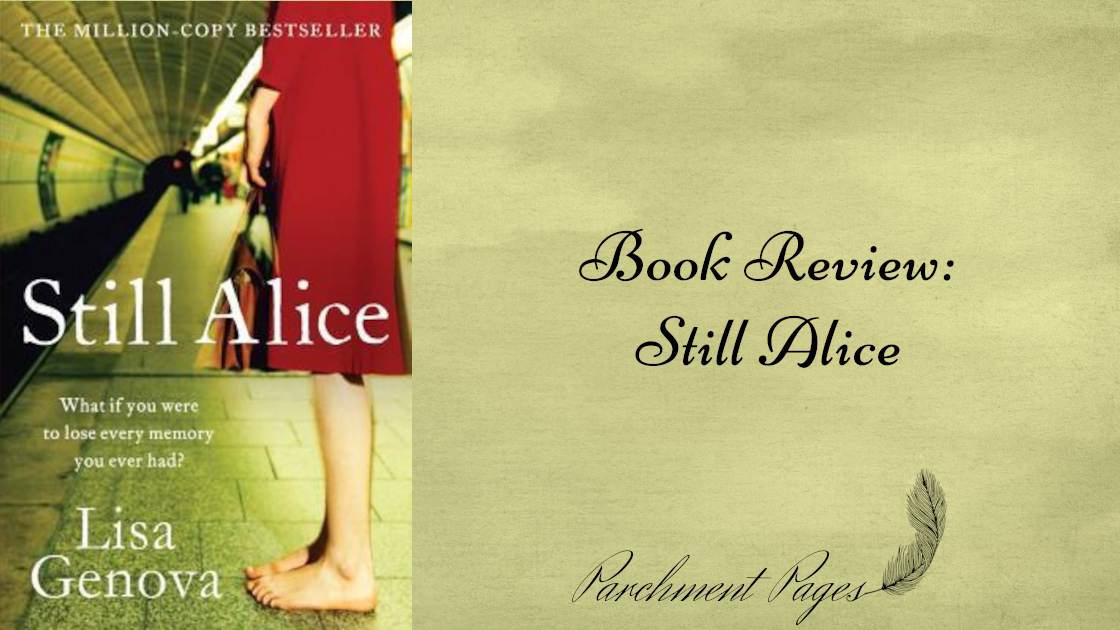

Title: Still Alice
Author: Alice Genova
Genre: Contemporary
Format: Paperback
Length: 351 pages
Publisher: Simon & Schuster
Publication Date: 6th July 2007
My Rating: ★★★★ (4 stars)
Goodreads | Storygraph
Synopsis:
When Alice finds herself in the rapidly downward spiral of Alzheimer’s disease she is just fifty years old.
A university professor, wife, and mother of three, she still has books to write, places to see, grandchildren to meet. But when she can’t remember how to make her famous Christmas pudding, when she gets lost in her own back yard, when she fails to recognise her actress daughter after a superb performance, she comes up with a plan. But can she see it through? Should she see it through?
Losing her yesterdays, living for each day, her short-term memory is hanging on by a couple of frayed threads.
But she is still Alice.
My Review:
I can’t stand the thought of looking at you someday, this face that I love, and not knowing who you are.
Alice Howland
Still Alice is a novel that I kept seeing advertised but I wasn’t sure if it was something that I would be interested in. I assumed it was going to be a chick-lit, a genre of book that has never really interested me. It was after a friend recommended that I read it (and I watched the film) that I decided to pick it up and read it.
The story isn’t melodramatic or emotionally manipulative. It’s a moving portrayal of an intelligent woman and her deteriorating mind. Alice is a linguist who is diagnosed with early-onset Alzheimer’s. I think this is what interested me the most about it. As a writer, I can’t imagine anything worse than forgetting the one thing you’ve spent your life studying; words. Of course, that’s not the only thing the disease takes from you, it takes away everything, your ability to function, to store information, to remember the people you’ve loved and even the people you’ve lost.
You move through Alice’s story with her, you feel her frustration, her sadness, her happiness. The reader is thrust into the situation with Alice, unsure of things that happened not five minutes before. Genova does a wonderful job in portraying the disease as it takes away Alice’s memories. How she forgets her daughter, Lydia, how she thinks her other daughter Anna, is her deceased sister Anne, how she forgets the layout of her house (i.e. where the bathroom is.) You feel her embarrassment and frustration at having the label of Alzheimer’s and the stigma that comes with it.
The narrative is told through Alice, and so there are parts of the plot that we lose because of this, but this adds to us understanding how it feels for someone with the disease. They get lost because their brains can’t comprehend everything that is going on around them. However, I believe the story could be even greater if it was in the first person instead of third.
You get to feel for the other characters as well. Even though you want to get angry at John for his avoidance, you can’t, because the hardest thing is to watch your spouse forget the life you built together, to watch them suffer. Not just a spouse, but to watch your parent forget that you’re related.
Genova holds a PhD in Neuroscience, and it shows in her confidence in her scientific explanations of the disease in her writing. She knows the small details and therefore the bigger picture is much more convincing. She has created a brilliant story and brought attention to this debilitating disease, and I am so glad that she self-published this story because this is one that needed to be told.